
Running on Empty: Australia’s 30-Day Oil Problem
- Elizabeth Yong

- Mar 20
- 6 min read
Energy shocks are not unusual in global markets. Conflicts, supply disruptions and geopolitical tensions, especially those impacting oil-concentrated regions, regularly send oil prices higher and test the resilience of national energy systems. Yet the current surge in oil prices and disruptions to global energy trade are raising a more uncomfortable question for Australia than for many other developed economies: how resilient is its fuel supply if international supply chains are disrupted?
While many countries maintain large strategic reserves or domestic refining capacity cushion such shocks, Australia relies more heavily on international supply chains to keep its transport system running. As the current crisis continues to unfold, it is highlighting how quickly global disruptions can translate into domestic economic risks for countries with limited buffers in their fuel supply systems.
How Geopolitics Moves Oil Markets
The Strait of Hormuz is the most critical chokepoint in the global energy system, a maritime passage through which 20 million barrels of oil flowed daily in 2024, equivalent to approximately 20% of global petroleum liquids consumption (EIA, 2025). As Australia relies on refined fuel imports from Asian refineries that are themselves supplied through Hormuz-adjacent supply chains, a disruption at this single point of concentration is a direct threat to domestic fuel availability. The scale of that disruption is now being priced into global markets in real time. Following an Israeli strike on Iran's South Pars gas field on March 18, Brent crude rose more than 5% to approximately US$108.66 a barrel, up roughly 80% since the conflict began, marking one of the most dramatic oil price rallies in years (Associated Press & Reuters, 2026). Insurance costs for vessels have risen sharply and tanker traffic has dropped by approximately 90%, underscoring how rapidly a single chokepoint can translate geopolitical conflict into economic shock (Reuters, 2026b; NBC News, 2026).

Figure 1. The Strait of Hormuz. Approximately 20 million barrels of oil per day pass through this narrow corridor, equivalent to around one-fifth of global petroleum liquids consumption. Source: U.S. Energy Information Administration (2025).
Australia’s Energy Security Paradox
Australia is one of the world's largest exporters of coal, iron ore, and liquefied natural gas, yet it remains heavily dependent on overseas supply chains for the refined transport fuels that keep its domestic economy functioning (Department of Industry, Science and Resources, 2025). That contradiction lies at the heart of Australia's energy security problem.
Part of this vulnerability reflects the gradual decline of Australia's domestic refining capacity. Australia once operated eight oil refineries, but today only two remain: Viva Energy's Geelong facility and the Ampol Lytton refinery in Brisbane (SBS News, 2026). Over time, cheaper refining costs across Asia made individual refinery closures economically rational. However, the cumulative result is a growing reliance on imported refined fuels, leaving Australia exposed to the type of disruption observed during this crisis.
The geography of Australia's fuel supply chain further compounds this exposure. Fuel cargoes from Asian refineries typically take around 20 to 25 days to reach Australia as finished product, while the full supply chain, from crude oil extraction to refined delivery, can take between 30 and 40 days (Macquarie University Lighthouse, 2026). As a result, sustained disruptions to global shipping routes can begin affecting domestic supply within weeks rather than months.
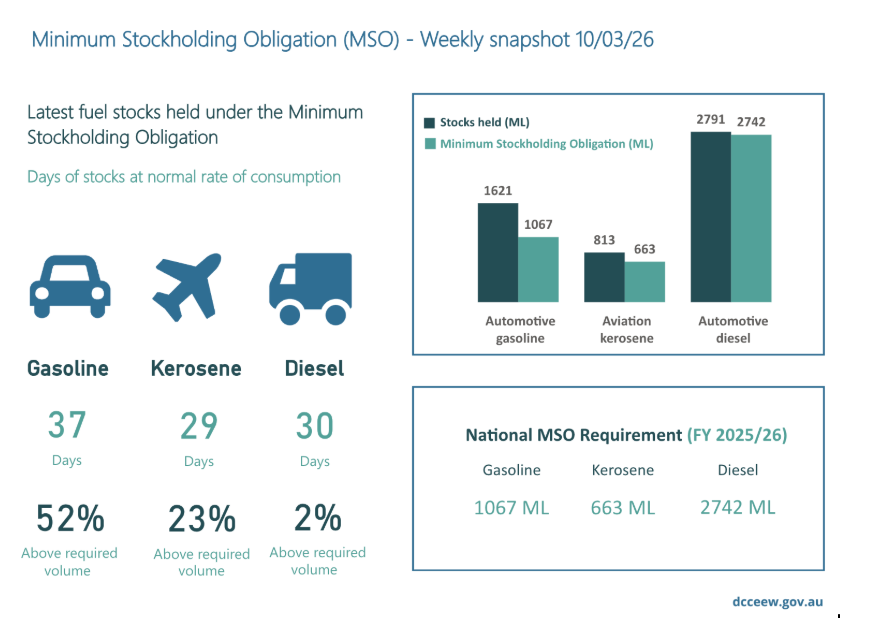
Figure 2: Australia’s fuel stocks held under the Minimum Stockholding Obligation (MSO), showing days of supply for gasoline (petrol), aviation kerosene (jet fuel) and diesel at normal consumption rates. Source: Minimum stockholding obligation (MSO) for liquid fuels: statistics, Department of Climate Change, Energy, the Environment and Water (2026)
As shown in Figure 2, Australia holds approximately 37 days of petrol, 30 days of diesel, and 29 days of aviation fuel at normal consumption rates as of March 10, 2026. These levels remain well below the International Energy Agency’s requirement of 90 days of net imports and also fall short of Australia's own domestic target of around 50 days (Department of Climate Change, Energy, the Environment and Water, 2026). By comparison, most IEA member countries hold an average of roughly 140 days of fuel reserves (SBS News, 2026).
Australia has been non-compliant with the IEA stockholding requirement since 2012, not because the risk was unknown, but because sustained policy action to address it never gained sufficient urgency. Governments, industry groups, and researchers have repeatedly warned about this vulnerability over the past decade. However, a long history of uninterrupted supply meant the risk remained largely theoretical until the disruption in 2026 made it tangible. Australia's challenge is not a shortage of energy resources, but a reliance on global infrastructure to refine and transport them.
Economic and Market Implications
The Inflation and Policy Channel
Oil price shocks transmit through transportation and logistics costs to the broader price of goods and services, affecting households regardless of whether they own a car. Between late February and mid-March 2026, average petrol prices rose by nearly 50 cents per litre across Australia's five largest capital cities (SBS News, 2026), representing an additional $1,500 per year for a household filling a 60-litre tank weekly.
Scenario analysis by Read and Macdonald-Smith (2026) suggests sustained oil prices above US$100 per barrel could push Australian inflation above 5%, at a time when headline CPI was already running at 3.8% in January 2026 (ABS, 2026). These concerns were realised on March 17, when the Reserve Bank of Australia's Monetary Policy Board raised the cash rate target by 25 basis points to 4.10%. In its statement, the Board noted that while inflation had fallen substantially since its 2022 peak, the conflict in the Middle East had resulted in sharply higher fuel prices which, if sustained, would add to inflation, and that short-term measures of inflation expectations had already risen (Reserve Bank of Australia, 2026).
The decision reflected the Board's judgement that there was a material risk inflation would remain above target for longer than previously anticipated. Yet as senior economist Matt Grudnoff has noted, because the inflationary pressure stems from a supply disruption rather than excess demand, higher interest rates address the symptom rather than the source, leaving Australian households facing both rising fuel costs and tighter borrowing conditions simultaneously (Grudnoff, 2026).
Sectoral Divergence and How Markets Price Structural Risk
This tightening cycle played out unevenly across sectors. Energy producers with direct exposure to oil and LNG prices sit on the opposite side of this shock from fuel-intensive industries, such as airlines and logistics, where higher input costs directly compress margins.
This difference reflects a common idea in equity analysis: commodity shocks rarely affect the entire market equally, but instead shift relative performance across sectors. The S&P/ASX 200 declined by approximately 1.3% on 11 March 2026, and by closer to 4% on the most severe trading session of the period (CommBank Market News, 2026; Reuters, 2026a). In contrast, ASX listed energy producers, such as Santos and Woodside, moved in the opposite direction, as unhedged oil and LNG exposure meant that rising Brent prices translated directly into stronger earnings outlooks, widening the performance gap between energy and the rest of the market (Tuckwell, 2026).
Beyond the immediate price response, markets are also beginning to assess whether Australia's fuel vulnerability represents a longer-term structural issue rather than a temporary shock. Companies involved in domestic energy production, storage infrastructure, or supply chain diversification could benefit from greater policy attention to energy security. At the same time, sectors such as consumer discretionary may face additional pressure as higher fuel costs reduce household spending capacity.
The closure of domestic refineries, the failure to meet IEA stockpile requirements, and the reliance on just-in-time supply chains were each individually defensible decisions. Collectively, they left Australia with almost no buffer at the moment one was needed. The question now is not whether Australia can manage a short-term disruption. It can, through emergency releases and demand management. The real question is what kind of energy security framework Australia builds for a world where geopolitical shocks are a recurring feature rather than an exception.
Reference List
Australian Bureau of Statistics. (2026, February 26). Consumer Price Index, Australia, January 2026. Australian Bureau of Statistics. https://www.abs.gov.au/statistics/economy/price-indexes-and-inflation/consumer-price-index-australia/latest-release
ABC News. (2026, March 13). Australia releases petrol and diesel from emergency stockpile. ABC News. https://www.abc.net.au/news/2026-03-13/petrol-diesel-released-emergency-stockpile-iran/106450556
Associated Press & Reuters. (2026, March 18). Oil prices surge after Israeli strike on Iran's South Pars gasfield. Al Jazeera. https://www.aljazeera.com/news/2026/3/18/oil-prices-surge-after-israeli-strike-on-iran-gasfield-irans-threats
CommBank Market News. (2026, March 12). ASX smashed $40bn as oil prices surge. Commonwealth Bank of Australia. https://www.commbank.com.au/articles/newsroom/2026/03/asx-smashed-40bn-oil-prices.html
Department of Climate Change, Energy, the Environment and Water. (2026). Minimum stockholding obligation (MSO) for liquid fuels: statistics. Australian Government. https://www.dcceew.gov.au/energy/security/australias-fuel-security/minimum-stockholding-obligation/statistics
Department of Industry, Science and Resources. (2025, September 18). Resources sector plan. Australian Government. https://www.industry.gov.au/publications/resources-sector-plan
Grudnoff, M. (2026, March 16). If RBA followed the evidence, it would hold rates. It probably won't. InDaily. https://www.indailysa.com.au/news/opinion/2026/03/16/interest-rates-petrol-middle-east
Macdonald-Smith, A., & de Kretser, M. (2026, March 13). China asks refineries to cancel jet fuel cargoes, raising supply risks. Australian Financial Review. https://www.afr.com/companies/energy/china-asks-refineries-to-cancel-jet-fuel-cargoes-raising-supply-risks-20260313-p5oa7c
Macquarie University Lighthouse. (2026, March). Could Australia run out of petrol? Macquarie University. https://lighthouse.mq.edu.au/article/2026/march-2026/could-australia-run-out-of-petrol
NBC News. (2026, March 5). Shipping slows to a crawl through Strait of Hormuz, threatening to snarl international trade. NBC News. https://www.nbcnews.com/business/economy/shipping-slows-crawl-strait-hormuz-threatening-snarl-international-tra-rcna261797
Read, M., & Macdonald-Smith, A. (2026, March 9). Defence taps industry for jet fuel as oil crisis deepens. Australian Financial Review. https://www.afr.com/policy/foreign-affairs/defence-taps-industry-for-jet-fuel-as-oil-crisis-deepens-20260309-p5o8oa
Reserve Bank of Australia. (2026, March 17). Statement by the Monetary Policy Board: Monetary Policy Decision. https://www.rba.gov.au/monetary-policy/rba-board-minutes/
Reuters. (2026a, March 14). Aussie stocks seesaw as oil hovers near $US100 a barrel. Reuters. https://www.reuters.com/markets/asia/australian-shares-drift-lower-oil-prices-rally-2026-03-14/
Reuters. (2026b, March 9). Oil surges as Iran war fuels supply fears. Reuters. https://www.reuters.com/business/energy/view-oil-surges-20-iran-war-fuels-supply-fears-2026-03-09/
SBS News. (2026, March 14). Amid rationing and shortage fears, here's what Australia's fuel supply looks like in charts. SBS News. https://www.sbs.com.au/news/article/australia-fuel-shortage-2026/zl0grg7ey
Tuckwell, D. (2026, March 9). Why oil and LNG prices are spiking, and what it means for Santos and Woodside. Livewire Markets. https://www.livewiremarkets.com/wires/why-oil-and-lng-prices-are-spiking-and-what-it-means-for-santos-and-woodside
U.S. Energy Information Administration. (2025, June). Amid regional conflict, the Strait of Hormuz remains critical oil chokepoint. U.S. Energy Information Administration. https://www.eia.gov/todayinenergy/detail.php?id=65504


Comments